MLK but make it sports
Dr. King wrote, "All segregation statutes are unjust because segregation distorts the soul and damages the personality."
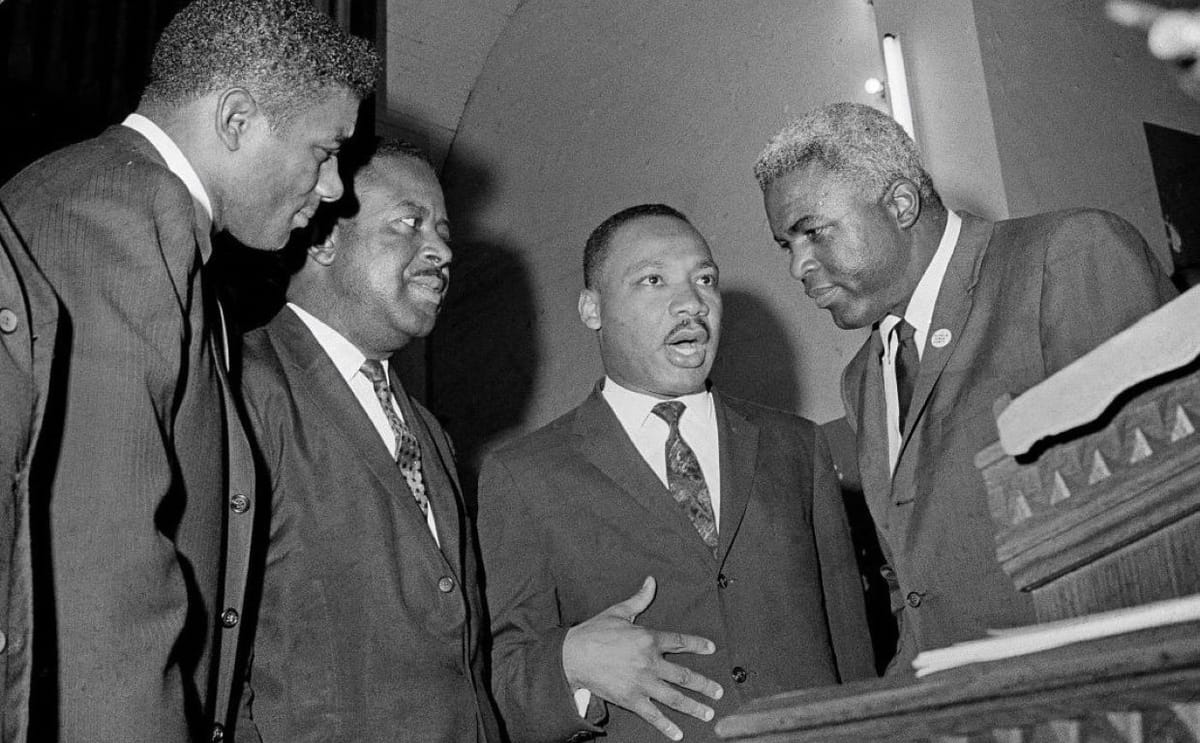
What consistently gives me pause about the life of Dr. Martin Luther King, Jr. is that, like fellow slain civil rights activists Medgar Evers and Malcolm X, King did not reach the age of 40. King’s wisdom and his presence that one can feel permeate a photo or video clip has always made him seem older. That King was murdered at 39 evokes both tragedy for not just the act but so many years cut off but also awe in his ability to accomplish what he did and establish himself one of the most distinguished figures in American history in those so few years.
This here is purportedly a sports-ish blog, and King was not known for much of a public rooting interest in sports themselves. He did, though, understand the power of sports to get the American public to pay attention when those sports mixed with the real world. In 1961, before both men had reach their respective peaks of fame, King sent a telegram to then-Cassius Clay reading, “Your youthful good humor, physical prowess, and flippant charm have made you an idol to many American young people. May God protect you and your opponent in the coming contest.”
Years later, despite their public political differences, King backed Muhammad Ali’s choice to not submit to the Vietnam War draft. “He’s doing what he’s doing on the basis of conscience,” King said. “He’s absolutely sincere. I will strongly endorse his actions.”
Prior to that, King had formed a relationship with Jackie Robinson, encouraging the latter to get more involved in civil rights. King even said, “Jackie Robinson made my success possible. Without him, I would never have been able to do what I did.”
While many have sought to remind us more than five decades after his assassination, it still largely fails to stick with much of America that King—sainted today with his own holiday—was despised by most of America in the time leading up to his death. A May 1963 poll of Americans had only Soviet leader Nikita Khrushchev viewed more negatively than King. Per Gallup:
Gallup Polls chronicling public attitudes toward King, personally, start with a May 1963 survey, conducted one month after King penned his open "Letter From Birmingham Jail," in which he argued that "one has a moral responsibility to disobey unjust laws." In that survey, Gallup found nearly as many Americans holding an unfavorable view of King (37%) as held a favorable view (41%).
In August 1964, a year after King's "I Have a Dream" speech at the March on Washington for Jobs and Freedom, and a month after President Lyndon Johnson signed the 1964 Civil Rights Act into law, the picture was not much different: 44% of Americans had a favorable view of King and 38% an unfavorable view.
Between August 1964 and Gallup's next favorability measure on King, in May 1965, King won the Nobel Peace Prize for his nonviolent efforts to end segregation and racial discrimination. However, in that May 1965 poll, public opinion of King was even more negative than it had previously been: 45% of Americans had a favorable view of him and 46% an unfavorable view.
In 1965, King began to speak out against the Vietnam War, and in 1966, he and his family moved from the South to the slums of Chicago, where he joined other black leaders in agitating for an end to housing and employment discrimination, among other reforms. An August 1966 poll found public attitudes toward King the most negative to date: 33% favorable, 63% unfavorable.
Yet more than eight in ten adults have a favorable view of Dr. King today. Since King himself has not been able to actively do anything to change the public’s perception of him in the last fifty-plus years, it seems strange that collective America just arbitrarily chose a drastic shift in opinion on the man. But that’s what happens when a controversial figure like King cannot fight back against the whitewashing of his life and legacy, as his work has been boiled down in many circles to just his “I Have a Dream Speech,” particularly the line oversimplified and misapplied so often in bad faith about content of character vs. color of skin. It’s particularly insulting if one knows that King both spoke shortly before his death of that “dream” having become a nightmare…
…as well as having commenting years before that speech on how exactly those types of words get so readily twisted for sanitized public consumption. In 1947 King observed:
We are prone to let our mental life become invaded by legions of half truths, prejudices, and propaganda. At this point, I often wonder whether or not education is fulfilling its purpose. A great majority of the so-called educated people do not think logically and scientifically. Even the press, the classroom, the platform, and the pulpit in many instances do not give us objective and unbiased truths. To save man from the morass of propaganda, in my opinion, is one of the chief aims of education. Education must enable one to sift and weigh evidence, to discern the true from the false, the real from the unreal, and the facts from the fiction.
Those thoughts are especially glaring in the current toxic informational environment in which we find ourselves. That’s not the cuddly King convenient for today’s politician speech or the shaming of a current social protester. It’s not the King that gets a soft piano as a sports broadcast fills a timeout in the action to remind you that the man did … something all those years ago (but not to encourage you to really dig into what).
While it’s long been obvious that the cudgel-quoting “content of character” folks are not serious people and willfully ignore that the true theme of King’s speech was freedom for all, their intentionally-dubious use of King’s words have an added hypocrisy today when so many of them would so vehemently seek to exclude some people from participating in sports for reasons that are not about character, at least not in an interpretation of the word rooted in decency. As the elective representatives of the American people move ever closer to legally barring some kids from having fun with their peers, none of those who vote in favor of doing so will likely cite King when he said in his letter from a jail in Birmingham (where he was being held for publicly protesting, by the way),
"Any law that uplifts the human personality is just. Any law that degrades human personality is unjust. All segregation statutes are unjust because segregation distorts the soul and damages the personality. It gives the segregator a false sense of superiority and the segregated a false sense of inferiority. Segregation, to use the terminology of the Jewish philosopher Martin Buber, substitutes an ‘I it’ relationship for an ‘I thou’ relationship and ends up relegating persons to the status of things. Hence segregation is not only politically, economically and sociologically unsound, it is morally wrong and sinful. Paul Tillich has said that sin is separation. Is not segregation an existential expression of man's tragic separation, his awful estrangement, his terrible sinfulness?"
That same letter notably called out the moderates “more devoted to ‘order’ than to justice; who prefers a negative peace which is the absence of tension to a positive peace which is the presence of justice.” The same who today will avoid the uncomfortable words of a man who called out the conflicts in their logic.
It's impossible to know what Dr. King would say directly about such a sports issue today or our political climate overall. We can only apply the evidence he intentionally gave us while alive. But we know that he would want us to do so faithfully, not selectively.