It's all political
It is the job–and often the moral imperative–of any sports commentator who is worth their salt and who is not trying to deceive their audience into treating sports as an excuse to ignore the rest of the world to speak on matters that cross into the political.
We have currently a built-in allergy to unpleasant or disturbing information. And our mass media reflect this. But unless we get up off our fat surpluses and recognize that television in the main is being used to distract, delude, amuse and insulate us, then television and those who finance it, those who look at it and those who work at it, may see a totally different picture too late.
While the “shut up and dribble” bacteria is always lurking and ready to poison the discourse at the intersection of sports and the political, it has been a while since a prominent voice has, rather than attempting to silence a sports figure with a cogent non-sports thought, has declared that sports themselves should not be political. But then Heisman winner and former ESPN analyst Robert Griffin III entered the chat.
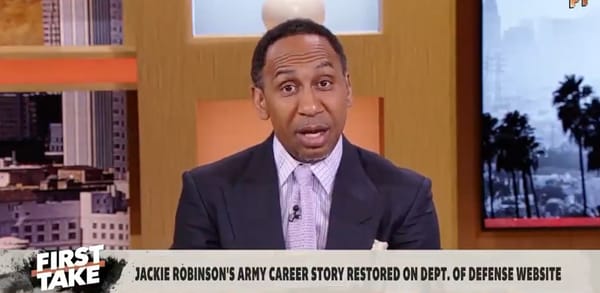
On Thursday, amid righteous uproar over the Department of Defense removing info about war veteran and civil rights hero Jackie Robinson from its website and then later restoring it without valid explanation for either move, ESPN’s Stephen A. Smith called out the President of the TV for his anti-DEI quixotic crusade reaching an American hero like Robinson (and also challenged POTVS to a debate about DEI).
When you look at the actions of this administration and you’re talking about DEI–diversity, equity and inclusion–and you’re equating that with Black people and you’re using words like ‘unqualified’… Pete Hegseth is the head of the Defense Department. He has served our country with honor. I am not trying to knock him or denigrate him in any way… but the fact of the matter is, how is he not DEI? He was a soldier, and then he was a host on Fox News on the weekends, and he goes from that to being the head of a Defense Department that oversees more than 3.5 million people. . . . He happens to be white, but we don’t mention DEI when it comes to him. Why not? The biggest beneficiaries of affirmative action and DEI, some would argue, are white women. How come we don’t mention that? Why is it always attached to Black people? This is the kind of stuff that we’re asking ourselves, and on a day like today it gives us more credence to ask that question because of what happened with Jackie Robinson, who served in our military, drafted, served our country, and for hours upon hours in a day his stuff was scrubbed, and we’re supposed to believe that’s accidental?
Not long after Smith spoke out about this, RGIII posted the following:
This tweet is not about Jackie Robinson.
— Robert Griffin III (@RGIII) March 20, 2025
His significance can never and should never be erased.
Breaking the color barrier in baseball in itself is not political.
Jesse Owens winning 4 Gold Medals in itself was not political.
Jack Johnson becoming the 1st Black Boxing…
Look, RGIII, I get it. Reflexively, nobody wants the peanut-butter-in-my-chocolate routine when it comes to sports and the murky and malleable term “politics,” and every sports fan--including me–would prefer that sports could exist in a vacuum untainted by conflicts of wealth, race, religion, etc. But nearly everything about sports outside of the chalk lines and whistles is political.
Issues that affect the body politic–wealth, race, religion, gender, sexuality, law enforcement, military, public health, the media itself–are inherently political, and sports at any given time intersect with all of them. Fighter jets flying over a stadium during “The Star-Spangled Banner” is as much a political act as kneeling during that anthem. An owner angling for public funds for that stadium is political. Shaquille O’Neal both being named an honorary sheriff’s deputy and his support for police that garnered it are political. A baseball player being denied an opportunity because of his race is extremely political, as is the act of crossing that man-made boundary.
And if your beef was specifically with Smith and anyone else on TV commenting specifically on figures and departments in the US government, it’s important to note that the administration injected itself into the sports discussion here. It didn’t have to touch Robinson’s page on that website, and ignoring such an incident involving one of the most iconic American sports figures ever would be malpractice by a sports journalist or commentary show like First Take. Elected officials and their appointees putting their fingerprints on issues of sports is as political as Barack Obama publicly making his NCAA Tournament picks both while in office through this year.
Regarding the other “not political” items on your list, let’s break down each.
“Jesse Owens winning 4 Gold Medals in itself was not political.” That man stuck those Gold Medals in the face of Adolph Hitler, who was using the 1936 Olympics to advertise his white supremacist regime, and Owens’ own grandson has called the achievement “a thumb in the eye” to the dictator.
“Jack Johnson becoming the 1st Black Boxing Heavyweight Champ in itself was not political.” See Robinson, Jackie. But further, the National Museum of African American History & Culture notes regarding Johnson’s pursuit of the title, the controversy of which he was well aware:
Boxing fans viewed the sport through the lens of nationality and race. A White boxer defeating a Black opponent reinforced ideas about white supremacy. But if the Black man won, it would contradict ideas about white superiority. For Johnson to have the championship crown amidst imperialism, Jim Crow, and global white supremacy, boxing fans deemed it unacceptable.
“They all had political ramifications. They all challenged the status quo of racial barriers to fair play, race relations and civil rights.” Then you’re acknowledging these are political acts. Something having “political ramifications” solidifies it as political. This should seem very obvious.
“They shouldn’t be used as an excuse to push political agendas on sports shows on national television to an audience there to consume sports content.” Again, Stephen A. Smith or anyone else on TV or radio or podcast or print column or blog (hi!) having a take on a championship team choosing to visit the White House or not or a take on trans girls/women participating in organized sports are “political agendas.” When a figure in partisan politics crosses into the sports sphere in any way–even just attending a game–that choice is a political one and turns the theater of sports into a political one as well. No matter how much you and I might wish they wouldn’t.
A presidential administration attempting to alter the public’s understanding of history by erasing factual info about those who have contributed to that history, including sports figures, is a political act. And it is the job–and often the moral imperative–of any sports commentator who is worth their salt and who is not trying to deceive their audience into treating sports as an excuse to ignore the rest of the world to speak on that.